Thursday, May 24, 2007
Visualising the web
I have just come across Walk2Web, a tool for visualising web sites. I haven't yet worked out exactly what it does, but I think that the way that it offers a view of surrounding sites (that link back), and a history of ones exploration are very interesting. http://walk2web.com/

Sunday, April 15, 2007
One Laptop Per Child

The first One Lap Top Per Child school has received its computers, and I am sure that the teachers and children and community are very pleased with them. You can see more pictures at http://news.com.com/2300-1041_3-6175025-2.html?tag=ne.gall.pg
including children smiling with their shiny new computers.
While there is something to be said for Negreponte's One Laptop Per Child programme, and the computers cost $100 each and are wind up I do wonder if this is the most useful use of resources in a country that has huge class sizes, considerable poverty and easily curable diseases.
It seems to me to be part of the furore over the "digital divide" from a few years ago, which wasn't a digital divide at all, it was, and is, a wealth divide. Poor people have less access to technology because they are poor. The solution is not to give them bits of technology but to address the underlying causes. But that is more expensive, more difficult and if really done would affect the life styles of the rich:
 Nigeria has something like 80 million children, so perhaps 50-60 million school age children, so the cost of simply buying the laptops is $8 billion. On top of this each school will require a satellite dish to connect to the internet - and that will need powering, so will require a generator and then there will be whatever the connection (usage) costs might be.
Then there is staff training if the computers are to be used effectively in school the pedagogy needs to change from one which is based on lack of resources - including text books - with the result that it is highly didactic to one which is based more on participation and sharing. This will be a huge culture shift for the whole of society. It may well be a good thing, but without such a change the project is likely to end up as little more than a way of downloading electronic text books. (Plus any personal use that the children may make of the computers).
If I am right about this then the cost of the computers will be a small fraction of the total cost of implementing a meaningful One Laptop Per Child programme. - running the systems, developing resources, staff training, IT support etc.
Wednesday, January 31, 2007
The Shock of the Old

The Shock of the Old
David Edgerton
Profile Books
Published by my brother, and I met the author at one of his parties last year.
The thesis of the book is that most books which discuss technology focus on innovation and invention rather than use, and thus paint a false picture of technology and what it means. He argues that there is a relentless focus on the new, and that this results in the same story being told over and over again for each new technology. Thus, he cites the idea that various technologies have been offered up as making war unthinkable - aeroplanes and the atomic bomb being two of them. His point being that each of these technologies is repeating exactly the same ideas as the previous and that they will not have the supposed effect.
His more important and profound point though is that it is use not novelty that is important, so that new technologies actually only have a small impact and those that do have an impact will continue to for a long time, particularly when you take a world rather than a western view of the technologies. Examples he gives include that Hitler used more horses to invade the Soviet Union in World War II than Napoleon did during his invasion; and that more people were (and still are) killed by personal weapons (guns, pistols etc.) than by newer weapons, providing convincing figures. Or, he argues that printing, or radio have greater impact than the newer internet because in many countries the penetration of the older technologies is so much higher, and China and India alone account for half the worlds population, so what they are doing is important.
I have a lot of sympathy for his argument, though find the style very polemical and sometimes off putting, and I think that there are (some) counter examples. For instance, mobile phones are available in places which have never been wired for old fashioned telephony.
I do think that it is a useful antidote though for all the techno-enthusiasts who chase one new technology after another thinking that it is the solution to all problems as we have seen with learning objects, VLEs, Web 2.0 / education 2.0, PLEs, eportfolios etc. etc. Each of these has been offered as the solution (sometimes even by the same people) precisely because they lack both the historical and the usage model that he cites.
Anyone who is looking at new technology should read this.
Thursday, January 25, 2007
Successful prosecution under Disability Discrimination Act
The Project Management Institute has been prosecuted under the DDA for discrimination in the provision of an exam to a blind student. They failed to provide an adequate version of the course materials, and refused to make necessary adjustments in the examination.
details available at: http://www.theregister.co.uk/2007/01/25/computer_based_exam_discriminated_against_blind_candidate/
details available at: http://www.theregister.co.uk/2007/01/25/computer_based_exam_discriminated_against_blind_candidate/
Wednesday, September 13, 2006
safer cycling for hairy ones
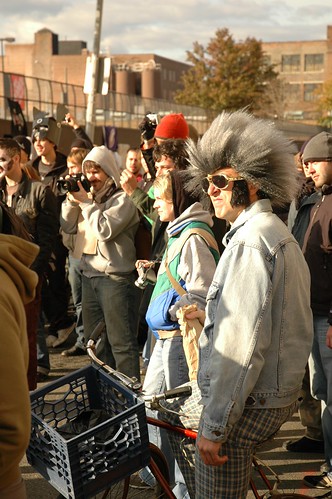
As a keen cyclist I came across this interesting article which suggests that if you want to be safe on the roads you should wear a long wig..... http://www.telegraph.co.uk/news/main.jhtml?xml=/news/2006/09/11/ucyclists.xml
get geeky!
 Sometimes one sees things that are seriously geeky that just make you smile, and one I have just come across is USB Geek.com at http://www.usbgeek.com/
 They offer a wide variety of things including USB powered gloves (that would stop you wandering away from your computer), USB powered shredder (for business cards only as far as I can see) and USB powered pencil sharpners. Is there no end to the futility of man?
Monday, June 26, 2006
hijacking technology
Apparently children are using the noise that was designed to be audible to them, but not to adults, as ring tones. The noise was created to discourage children from congregating in places like shopping centres. However children have now started using it as a ring tone on their mobile phones. That way teachers (or at least most teachers) will be unable to hear it, whilst they can.
Besides showing the ingeniousness of children it also is a wonderful demonstration of the law of unintended consequences.
Besides showing the ingeniousness of children it also is a wonderful demonstration of the law of unintended consequences.
Sunday, June 18, 2006
Wikis and blogs
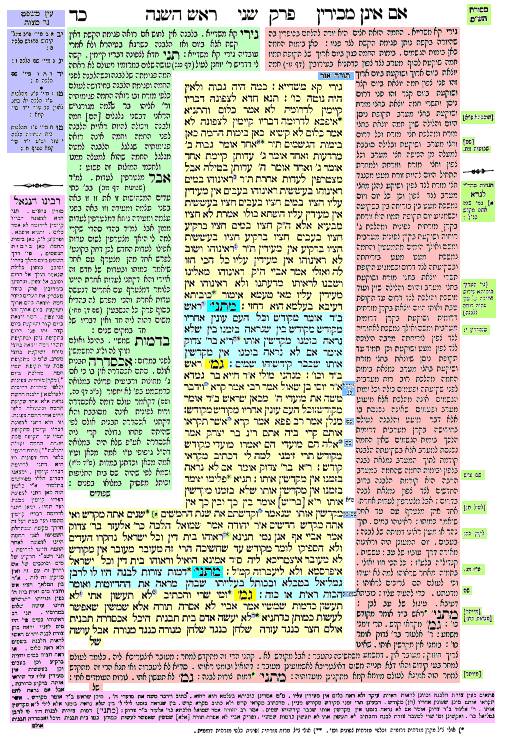
I have been thinking about wikis and blogs - and other parts of Web 2.0 - lately, and thinking that perhaps the ideas are not so new after all. The illustration here is taken from the talmud, which is around 1500 years old. It is somewhere between a blog (additive with an original posting and then a series of comments) and a wiki (postings updated and altered as time goes on, but possible to see the history).
Starting with a small piece of the Mishna there are a whole series of commentries on, written over hundreds of years and many places. Commentaries are continuing to be written on it, so that the discussion continues. An interesting article showing some the parts and a translation of a page (though with embedded Hebrew in the translation) can be found at http://www.templesanjose.org/JudaismInfo/Torah/Talmud.htm
Subscribe to:
Posts (Atom)